Category Archives: African American Legacy

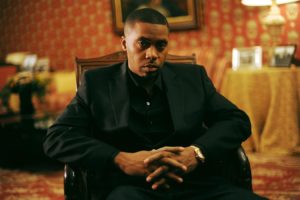
15 reasons why Rapper NAS is a Hip-Hop Icon!!!

by

 Samori Swygert

www.facebook.com/thegemix/

A few weeks ago, rapper Nas noted that he was tired of the nostalgic admiration of his debut album, ILLMATIC.  This album was released April 19, 1994, and it brought Nas much acclaim, notoriety, praise, and anchored him in HipHop history. The album debuted with only 10 tracks.

Fast-foward to 2019, Nas has pumped out a diverse catalogue from full LPs to Best of Albums, to an EP with Kanye West, and another round of his Lost Tapes series.   Nas has been a highly debated artist since his arrival on the over-crowded and highly competitive HipHop scene.  Nas has survived career-ending industry beefs, he’s outlasted several industry trends, gimmicks, and styles.

This Queensbridge King, seems to operate with his own pace, mystique, and walks to the beat of his own drum.  We’re not even talking about his success in the business arena with the Queensbridge Venture Partners.  What is it about Nas’s lyrical DNA that keeps him relevant and resonating with the people?

I think part of the answer is that he has a unique ability to master being INTROSPECTIVE, RETROSPECTIVE, and INNOVATIVE. He also masters the technique of PERSONIFICATION.  Personification is a writing technique in which the writer places themself in the position of another person or thing and narrates life from that perspective.  That is unique, AND THEN TO MAKE IT RHYME!

These literary gifts are in addition to the gritty street stories, cool persona, intellectual, and spiritual positions he takes. Nas then tops of his rhymes with the historical wisdom of an elder statesman. Nas is like (no pun intended) a well trained tour guide as he narrates the past so vividly and graphically when he gets retrospective.  Nas is like a Verbal-photographer.  He also becomes like Morpheus in the Matrix when he goes introspective and shares his thoughts, how he thinks, and what governs his judgement. When he gets innovative, he leaves you amazed at how he arrived at a final masterpiece from 1 single idea, or leaves you wondering, “what made you think of that?”

Nas is not just a “rapper”, he is one of  the 20th and 21st century great literary mentalists.

Below are 15 songs that Nas wrote throughout his career, and  ARE NOT ON ILLMATIC!

  1. Money is my bitch-  I Am (1999)
  2. I gave you power-  It was written (1996)
  3. Sekou Story-  Streets Disciple
  4. Who killed it?-  HipHop is Dead (2006)
  5. Rewind-  Stillmatic  (2001)
  6. 2nd Childhood-  Stillmatic (2001)
  7. Last Words-  Nastradamus (1999)
  8. World’s an addiction-  Life is Good (2012)
  9. Back When- Life is Good (2012)
  10. Doo Rags- The Lost Tapes (2002)
  11. A New World- Nastradamus (1999)
  12. Fetus-  The Lost Tapes (2002)
  13. Poppa was a Playa-  The Lost Tapes (2002)
  14. Project Window- Nastradamus (1999)
  15. One Mic- Stillmatic (2001)

Dr. Samori Swygert: Football strategies that can be used for black empowerment

Football strategies applied to Black Empowerment: Let’s Play!

by Dr. Samori Swygert

  originally published on: http://www.brothersonsports.com/dr-samori-swygert-football-strategies-that-can-be-used-for-black-empowerment/


It’s football season and for the most part, many Americans are attentively tuned into Sunday afternoon and Monday night football.  People will always ask you, ” Yo, did you see the game?”  In my head, I’m like “Are we saying the real game that’s being played 7 days a week, 365 days a year in perpetuity on Black America?”

Standing on the shoulders of our elders and scholars

I saw a very interesting video by Brother Amefika Geuka. He presented a brilliant analogy of black progress with football.  I thought his analogy was very intriguing.  I pondered over it while looking at a game earlier.  I began extrapolating further into his theory and I would like to put some more meat on the bone he presented.  So understand that this concept is not my original idea. I always believe in giving the appropriate credit and acknowledgement where it’s due.

What’s the objective?

The objective in this real life game is to score as many points possible to achieve independence and power that uplifts, sustains and advances Black America.

Routinely politicians and pundits ask that we lift ourselves up by the bootstraps, so it’s important that we devise and develop our own strategies of play.

Who are the players?

This is how I look at it:

The Line of Scrimmage- The line of scrimmage is anywhere African Americans live and operate

The Football– The football is equivalent to power, freedom, independence, capital, and autonomy

Quarterback- The quarterback are the parents in each family.  Parents must study, study, study, study and orchestrate the best plays.  They are responsible for ensuring that the football (please read what the football is above) is protected at all times and ultimately makes it to the end zone for a score.  Sometimes the parents have to do the rushing if they see a clearer path that wont endanger the children (A.K.A. wide-receivers).

Wide-receiver-  The Wide-receivers are our youth.  The same way wide-receivers break away from the path and run down field to catch the ball and score, is symbolic to our kids that engage the future and position themselves to receive capital, power, and support to score.  This is like Mark Zuckerberg of Facebook. His parents designed and positioned his path in such a way that he was ready to exploit the opportunity to score BIG once he received the ball.

Wide-receivers (A.K.A. our children) also can get the ball via inheritance and fortune if their quarterbacks (A.K.A. parents) have designed an effective play.

Running back- The Running back is our political strategist and community activist.  Like in regular football, they need to be quick, slick, versatile, and agile.  They can maneuver in and out of pockets with their wits, networking, and oratorical skills.  Their position is to help get many of our plans in motion all the way from grassroots level to the political arena where we can establish yardage in policy and legislation.

Linemen and Linebackers– The Linemen and Linebackers, like during an actual football game, have some size on them — we have offensive and defensive linemen.  Let’s say that our linemen are: black media outlets (TV, Radio, Internet,etc), Judges and Lawyers, Business Owners, HBCUs, Fraternities & Sororities, Scientists & Researchers, Mentoring Programs, Churches/Mosques/Temples, Civic Organizations, and Banks.

In staying true to a lineman’s big frame, we equate his physical size to a large membership or participant involvement in Black America.  So our strength would be an overwhelmingly high numerical participation in each category.  This means we want an exponential amount of black lawyers and judges, black banks and bankers, business owners, etc.  We need all of our linemen to be HUSKY WITH African Americans that are committed to the cause of black progress and independence.

Like linemen in football, we need them to provide protection and support for the quarterback when society is making plays against us.  Lobbyists, corporations, special interest groups, hate groups, police brutality (unnecessary roughness), the prison industry, and discriminatory policies/legislation are all trying to “sack the black quarterback.

We need our linemen to also bust open and bombard glass ceilings and closed doors of systemic and institutional racism and discrimination so we can run through the opening.

Speaking on injuries and attitude

Injuries can damage a team and diminish performance, and ultimately result in loss.  I equate injuries to losing any of our players to death, public scandals, political censure, incarceration, removal from office, blackmail, etc.  We must protect all players at all times and also know when to substitute players as to avoid fatigue and burnout.

Attitude is everything.  We can’t have any showboats that operate out of arrogance, selfishness, and ego.  Ball-hogging is not allowed.  We have no time or room for “Willie Beaman,” like on “Any Given Sunday.”  Know when to pass off on a lateral to another teammate that can execute or finish the play if you’re coming under heat or see a better opportunity arising to score.

Speaking on Fumbles and Turnovers

Fear, uncertainty, unpreparedness, failure to pay attention, and failure to communicate, often lead to fumbles, drops, and turnovers.  This affords the opposing team an opportunity to capitalize on our mistakes.  This is like failed legislation that should be specifically pertinent for the advancement and empowerment of blacks but somehow gets used against us and empowers everyone else. An example of this is affirmative action.  We dropped the ball on that and everyone else benefits from it.

And for God’s sake STAY OUT OF THE WAY OF EACH OTHER WHEN WE’RE ABOUT TO SCORE! 

I could go on and on but that would be too long if I elucidated all positions and different plays, but think about it.  Once again, this is just me building and adding on to Brother Amefika Gueka (shouts out to you).

Hit me on Twitter and let me know your thoughts: @docswagg06

Click Here to see the video by Amefika Gueka

2 Reasons why we haven’t advanced socio-politically

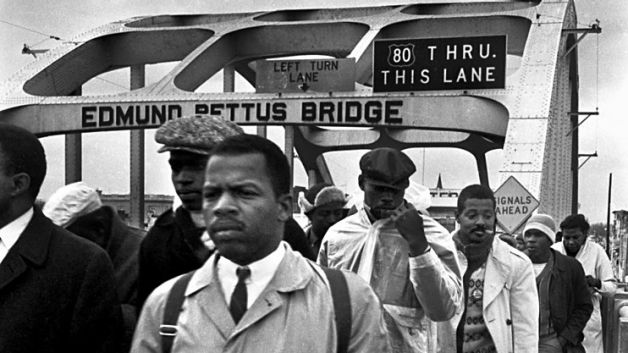
edmund

2 Reasons why we haven’t advanced socio-politically

By: Dr. Samori Swygert

Dr. Boyce Watkins wrote a great article for the website Financial Juneteenth. He discussed 5 reasons why he feels black men haven’t advanced over the last 40 years. I want to add an additional car onto his train of thought.

I’m postulating that 2 big reasons most socio-political movements within the black community fail are due to 1) an addiction to money and consumerism 2) the increasing focus on individualism versus community oriented efforts.

Why do I feel these 2 reasons are responsible for incomplete socio-political achievements in the black community? I’ve taken time to survey the numerous movements, marches, boycotts, vigils, prayer breakfasts, and protests. The duration of action, or the staying power of our efforts are typically ineffective because a substantial portion of us are not willing to sacrifice, endure discomfort, and be inconvenienced for a protracted period of time.

Addiction to money and consumerism

The addiction to consumerism and patronage debilitates any and all efforts when trying to accomplish goals. The Montgomery Busboycott was only successful because the African American demographic in that area refused to ride the buses for several months. This resulted in the crippling and dismantling of the transportation authority in Montgomery, Alabama. Our ancestors were committed to the cause in lock-step fashion. Were they inconvenienced? Did they have to make due through bad weather? The answer is yes to all of the above questions. However, their temporary sacrifice led to a permanent change in the bussing policy.

We must be completely committed and dedicated to boycotts and divestment of funds in institutions, facilities, and stores that either exploit, disrespect, or permit the subjugation of our people. This is exactly what the Anti-Defamation League does, the same thing the LGBT community does, and etc. Sure a store or brand may sell your favorite shoes, handbag, suit, sneakers, jewelry, cuisine, liquor, and etc. However, is that material item worth your human dignity?

Are we willing to financially empower the very people that seek to keep us subservient and noncompetitive? Can we tame our appetite of consumption? Fashion designers will spew an assortment of disrespectful intolerable comments about blacks, but some of us will still patronize their goods as if they weren’t talking about us, just to look fly.

We can’t give any credence to black entertainers, “purchased politicians”, or media-types. They have slick explanations why they won’t support boycotts and divestments. Many of them are defectors because they have endorsement deals or contractual obligations with these companies. Thus they will never offend the companies responsible because their money is at risk. Their loyalty is to the hegemony, not their heritage. Companies will create various incentives and bait to lure you away from your agenda. The moment we acquiesce and succumb to the allure, we demonstrate that our humanity is for sale.

This was illustrated with the California NAACP leader with Donald Sterling. He wasn’t able to forgo his addiction to cash. Also, we can have an excellent movement and all it takes is some dumb bought and paid rapper to go against the grain that co-opts the mind of impressionable youth that will side with him, but his only intention was to get paid by his corporate DON.

Individuality versus Community

Our attempts are also sabotaged by self-inflicted wounds of individuality. Our ego, narcissism, and selfishness prevents us from achieving in formidable success. Many of us take 100 mg of “Vitamin I” every morning, everything has to revolve around “I”.

This compromises and undermines any potential movement or progress as a group. Smart individuals understand that politics is a game of numbers. Show me your vote count from City Mayor to the President of the United States. I’ve seen us self-destruct and politically implode because of temporary short-sighted issues. We focus on the small issue which divides and derails us from achieving the main goal. When we lack solidarity and cohesiveness, we weaken the urgency and seriousness of our message.

Parents may disagree but they must show a unified front on house rules to the children. The parents then mitigate and resolve the other issues in isolated private time.

The LGBT and Latino community are highly successful to their goals because they’re unified, uncompromising, and relentless to their commitment to task. A dedicated and unified front forces their issues and agenda to the forefront of a nation’s itinerary.

This focus on self will weaken our collective voice politically, and economically. The focus on self dissolves our community and makes us susceptible to predatory and oppressive entities that seek to dominate us. Many socio-politico factions champion our regression to the “good ole days”, which weren’t good for us at all.

In closing, I feel we need to identify the major things we can agree on that will propel us forward by economic first, and secondly by politics. We are in a very fragile state of existence. Gentrification is happening all over the country, civil rights achievements are being reversed regularly, the prison industrial complex is booming, black unemployment is still at a critical level, college costs are rising, and global competition is at critical mass. We must put aside our ego, help our brethren, be receptive to help, appreciate help, be ready to sacrifice pleasure for an extended period of time, and MOVE!

29th Anniversary of the Philadelphia MOVE bombing ( May 13, 1985 )

29th Anniversary of the Philadelphia MOVE bombing ( May 13, 1985 )

by Dr. Samori Swygert

Today marks the 29th anniversary of the MOVE bombing in Philadelphia.  On May 13th 1985, Philadelphia Police engaged a house in West Philadelphia that was occupied by both adults and kids.  The occupants of this house were members of a group called MOVE.

The group was labeled and targeted by the authorities and informants.  According to various sources, the group was founded by John Africa, and the objectives were based on a retreat to natural living, communal growth, holistic medicine, animal rights, and was associated with the Black Liberation movement.

Some neighbors within the community complained to police and city officials about the group’s sanitary conditions.  Complaints detailed how an increase in rats, roaches, and other vermin started to plague the community because MOVE had constructed a compost of rotten food and waste.  Police and city officials also claim that some neighbors had grown irritated from loud bullhorn/speaker messages from the group during varying hours of the day.

City officials and police compiled a dossier of violations that would help justify engaging the group.  Police records of the group and its affiliated members composed of: illegal possession of firearms, parole violation, contempt of court, and terrorist threats.  MOVE members were socially labeled as radicals, and scrutinized emphasis was placed on their style of life and dreaded hair.

The confrontation and bombing stems from a historical feud between MOVE members, the police, and the late 1970s Mayor of Philadelphia Frank Rizzo. In 1978, an altercation ensued between MOVE members and police that resulted in a police officer (Officer Jim Ramp) being shot and killed, and nine members of MOVE (known as The MOVE 9) being incarcerated with prison sentences of 30 years to life.  Frank Rizzo had given the “okay” to bulldoze and fire hose the original MOVE house in a demolition.

The Aftermath of Carnage

Seven years later, police officers had shot tear gas canisters into the new home,  fired multiple shots, and reloaded their weapons and kept firing into the house while babies were crying.  A helicopter was manned and the police dropped two one-pound gel explosives onto the house with the adult and children occupants inside.  This maneuver accelerated an inferno that destroyed 61 homes — approximately four city blocks — and left nearly 240 people homeless.  The final tally revealed the death of six MOVE adults, and five children.  There were only two survivors: a child (Birdie Africa) and a young female (Ramona Africa). You ask “How did a bombing of one house result in the destruction of 61 house?”… The historical phrase “ LET THE FIRE BURN” was broadcasted over the communication between police and city officials.

Ramona Africa is still diligently and relentlessly pursuing the release and vindication of the nine members currently incarcerated.  Ramona still lives in Philadelphia, but travels all over the nation discussing the event and sociopolitical issues in America. She still embraces the group’s original philosophy.  Sadly, Birdie Africa died in 2013, in a tub aboard a cruise at the age of 41.

The houses and surrounding vicinity of Osage Avenue were restored by developers and were poorly rebuilt — requiring renovation/rehabilitation. Some of the developers embezzled up to $200,000 from the construction budget.  During the time of the bombing, Philadelphia was ran by an African American Mayor, Wilson Goode.

This story is very deep and should never be forgotten.  This should remain within the annals of African American History, and the experience of being Black in America.

Here are some links for you to do your own research.

1) To order the documentary Let the fire burn, on Amazon: http://www.amazon.com/Let-Fire-Burn-Michael-Ward/dp/B00HXT6O4C

2) A timeline of events surrounding the bombing:

http://www.philly.com/philly/hot_topics/93010634.html?c=r

3) PBS discussion of the bombing and an interview with Ramona Africa: http://www.pbs.org/independentlens/blog/let-fire-burn-fallout-29-years

U.S. calls for reparations now, but not for blacks

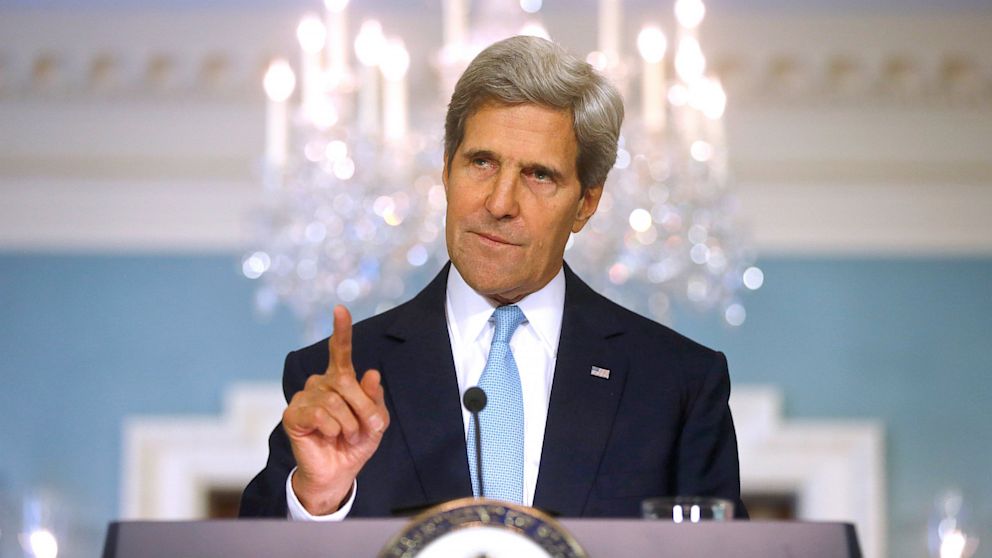
John-kerry

U.S. calls for reparations now, but not for blacks

Doc Swagg

This is lengthy but if you are African American, THIS IS EXTREMELY IMPORTANT.

The demand for reparations to African Americans starts NOW! I read an article last night in the Washington Post about how Secretary of State John Kerry, his advisers, and other State Department officials are in active negotiations with France to pay out REPARATIONS to U.S. Holocaust survivors.

The Background

Washington D.C.’s metropolitan subway system is designed by using color coded rail lines that demarcate which city sections it services. The city is developing its’ new Purple line route. A French company, Keolis, has won a $3 Billion dollar contract to construct this route. Keolis has a parent company, SNCF (Societe’ Nationale des Chemins de fer Francais). The route is 16 miles long. The Keolis subsidiary also has contract bids for railway systems in Florida, Massachusetts, and California.

This company is responsible for the transportation of approximately 76,000 Jews to Nazi concentration camps. According to the article, only 2000 Jews survived the slaughter. The French government had contractual agreements to compensate Holocaust survivors in the United Kingdom, Poland, Czech Republic, and Belgium. America was not included in the negotiations. $6 Billion has been paid to survivors in the aforementioned countries by the French government so far.

The U.S. General assembly is blocking further contracts to this company to build the Purple line until negotiations between France and the Keolis-SNCF connection are resolved and reparations are made.

The Discussion

The mere fact that the American government can currently acknowledge, engage, entertain, negotiate, and fight for payment of reparations to Holocaust survivors shows tremendous amounts of disrespectful hubris to African Americans. The Jewish community deserves their reparations to the fullest extent, they do!

However, the fact that our own country is mute, mum, and incredulously obstinate on righting the injustices done to African Americans in America is beyond belief. The first thing that will be said is that “there are surviving Jews from the Holocaust, and they have tracked down their Nazi affiliated violators”.

Well this is my answer. There is evidently no statute of limitations on time elapsed to bring violators and their benefactors to justice. Secondly, America has delayed, procrastinated, ignored, and refused to compensate African American reparations from generation to generation, thus, all surviving victims of American slavery have died off. The intentional, and negligent stalling on executing reparations has resulted in the temporal death of our ancestors that would fit the eligibility criteria for reparations as survivors of slavery.

America is delinquent in its attempt to address its iniquities and atrocities against African Americans. The failure to be accountable and assume a position of immunity against reparations is a slap in the face, especially when America is willing to negotiate with France to get reparations for Jews.

America,…….. are African American lives worth less than Jewish lives? If so, please furnish the criteria and protocol, and the authors of it. America didn’t ship Jews to Nazi concentration camps, but it will use African American tax dollars to conduct contractual commerce with a Nazi affiliated company and to facilitate payments of reparations to Jews. However, the United States itself, profited from the system of slavery for centuries, and AND NOBODY CAN BE HELD ACCOUNTABLE? WE CAN’T EVEN HAVE A CONVERSATION ABOUT IT? This is flagrant and blatant hypocrisy.

I’m not interested in hearing that we can’t trace back who was involved in slavery. We have several groups and organizations that have meticulously traced the beneficiaries, ancestors, and institutions that were active participants in slavery. For starters, John Kerry and President Obama can start by reading The Debt by Randall Robinson. I don’t know why president Obama is not for reparations.

The death of the participants in slavery doesn’t relinquish their ancestors and government from paying African Americans our reparations. WHEN I OWE BACK TAXES FROM YEARS AGO, I HAVE TO PAY IT OR THE GOVERNMENT WILL GARNISH MY EARNINGS AND CONFISCATE MY PROPERTY RIGHT? Here is my argument for beneficiaries that say they have nothing to do with slavery and that it was their great great grandfather that was involved. WHEN I OBTAIN PROPERTY, I ACCEPT ALL LIENS AND TAXES ON IT, AND I’M RESPONSIBLE TO PAY IT DESPITE THE FACT THAT I WASN’T THE PERSON THAT ORIGINALLY GENERATED THE LIEN.

African Americans were considered property, and that property has liens and back taxes on it that require payment on delinquent holders. The interest alone would bankrupt America!

This is why I am so impassioned about this. I see a clear double standard of justice happening before our eyes. The fact that MILLIONS of our African American ancestors lost their lives in the system of slavery and were never paid for the building of America is a resounding call for justice to be done. Let’s not selectively fight for and reward one group and deny another. How do we entertain talks on minimum wage today, when minimum wage for ancestors were Chitlins and bread? How do we talk strong on income equality today, when there was no income for African Americans period? How do we talk strongly on child labor laws, when children slaved day in and out for profit? How do we talk so strong about human trafficking, when human trafficking of African Americans raised America to capitalistic prominence and generational wealth?

The system of education demonstrates just one aspect of the crippling effects of slavery. Harvard was founded in 1636, Yale in 1701, Princeton in 1746, Columbia in 1754, Brown in 1764, Dartmouth in 1769, U of Penn in 1740. The Ivy League Schools are considered the upper echelon of education. Since Harvard’s founding, more than 2 centuries of education was afforded to whites, while concurrently and simultaneously, reading was a criminal act and books were contraband for more than 2 centuries for blacks. However, we allowed affirmative action to be sabotaged and dismantled. Aside from the Native Americans, no other ethnic groups in this country has been subjected to violent systemic subjugation in America. The Indians have received, and still receive subsidies from the American government.

I would like to quote what one of the Jewish Holocaust survivors said in the article. Leo Bretholz, a 92 year old survivor said, “It’s important for one reason: Justice should be done. When they [pay reparations], they admit they did something wrong-terribly wrong-sending people to be murdered.”

Finally, I’m going on record to say this is not about hate speech or being Anti-Semitic. I’m saying, African Americans want the U.S. government to actively work on compensation just like they are doing for the Jewish community. I stand as a single voice of millions that feel America should vigorously and diligently prepare compensation for African Americans and open negotiations. Stop hiding behind technical legalese, law lexicon, and constitutional verbiage and shoddy constitutional excuses and do what is right and just.

What are your thoughts, am I alone on this??

Source

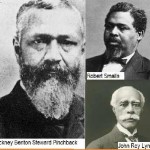
Unsung African American Politicians of the 1800s (part 1)

image

By: Doc Swagg

It’s refreshing to learn about great accomplishments in our rich African American legacy.  The more stories that we unearth and recover re-instills confidence, pride, and motivation.

The importance in debuting our heritage is because the current school curricula are not incorporating African American contributions into the history of America with the same emphasis as whites.

Our children need positive historical figures to identify and relate to.  White children can identify with  Columbus, Kennedy, Thomas Edison, Benjamin Franklin, Bill Gates, and a plethora of other names.  However, we should not have our history reduced to just a few.

My mother who is a graduate of Tuskegee University, and New York University had composed a list of African American politicians that don’t usually get the fanfare and recognition they should in history, and during Black History Month.  I would like to share this list with you.

The list is extensive, and I will break them down into a few parts.  Some of you may be familiar with these names, and some of us may be unfamiliar with these names.  This can serves as a guide for you to conduct your own in-depth research if you’re curious.

Okay let’s go…

By 1867, the Radical Republican’s Plan of Reconstruction divided the South into five military districts to protect the rights of the ex-slaves.  Under this law the federal commanders had power superseding authority granted to State governments.  The federal troops were stationed in the South to prevent many ex-confederates from participating fully in Reconstruction.  This plan of reconstruction enabled blacks the right to exercise the rights afforded them by the Constitution.  There were three groups that participated in Radical Reconstruction, the Freedmen, the Scalawags and the Carpetbaggers.

Blacks had not participated in the political process before, but they were eager to learn how to exercise their newly acquired rights.  The Slave Codes had prevented most slaves from acquiring an education, but now they were eager to get an education, as well as to participate in government. A few blacks had learned to read and write through secret means.

This period of black participation in politics was often defined as a chaotic time where ignorant, dumb and incapable men sat in high political offices.  Contrary to this view, many blacks who participated in Radical Reconstruction were intelligent men.  They were eager to rebuild the South for the benefit of all citizens.  Blacks in political offices appropriated money for some of the first public schools, buildings and roads.

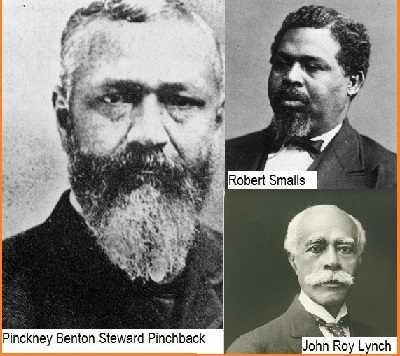
With the aid of federal troops, blacks were elected to serve as Congressmen and other high offices of trust.  Pinckney Benton Stewart Pinchback, was elected to serve as Lieutenant Governor of Louisiana after the impeachment of Republican Governor, Henry Clay Warmoth. His occupancy of the gubernatorial chair for forty-two days was the most impetuous times he had experienced, yet he was able to execute the duties of this office.
Pinchback was born a slave in 1837 on a plantation in Mississippi.  He was later manumitted with his mother, where they migrated to Ohio.  From the age of twelve, Pinchback was alone and making his own living.  He quickly gave up his boat life when he heard about the firing on FortSumter.  Eager to aid the North, he enlisted in the Union Army.

After the war, Pinchback took up residence in Louisiana.  In 1867, he organized the Fourth Ward Republican Club of Northern Louisiana.  Later, this club elected him to the State Republican caucus.  From that point on, Pinchback was a major figure in politics.  As a delegate to the State Constitutional Convention he introduced the 13th Amendment which warranted civil rights to all people of the state.

He served as a State Senator.  In 1868, Pinchback served as a delegate to the Republican National Convention in Chicago. He served as Director of the New Orleans School Board.  In the peak of his political career, Pinchback was elected U. S. Senator of Louisiana from a contested race held in 1873. He was finally denied this seat and was paid $16,666 for payment as salary until the denial was official.  Later he was elected to the U. S. House of Representatives, but again he was denied his seat.

There were other outstanding blacks who pursued political careers during the Reconstruction era.  Robert Smalls, who was famous for securing the “Planter,” a transport vessel, from the Confederacy served as a State Senator and a U. S. Congressman from South Carolina.

Blanche Bruce (Blanche Kelso Bruce) was elected U. S. Senator from Mississippi on March 4, 1875.  Prior to this office, he served as Sergeant-at-arms in the Senate of Mississippi.  After completing his term as U. S. Senator, Bruce was appointed Registrar of the treasury and was twice appointed Recorder of Deeds in Washington, D. C.

Hiram Rhoades Revels was elected U. S. Senator form Mississippi.  He completed Jefferson Davis term of office from February 25, 1879 to March 3, 1881.  He served as a State Senator of Mississippi before his election as U. S. Senator.  A native of North Carolina born in 1822, Revels left this state in later life to seek education in Ohio.  He studied at a Quaker Seminary.  Finally, he achieved his goal when he graduated from Knox College in Galesburg, Illinois.

James T. Rapier was a U. S. Congressman from Alabama.  Rapier had been successful in convoking a colloquy with men of labor in that state.  He organized the first Republican Party in Alabama with a platform calling for free press, free speech and establishment of a public school system.  He carried these ideas in his paper, “The Sentinel.”  Rapier received his education at MontrealCollege and the University of Glasgow, Scotland.

John Mercer Langston served as U. S. Congressman from Virginia from 1889 to1891.  A son of a slave master, John Mercer Langston was educated as a lawyer.  He served in many public offices: minister-resident to Haiti, school inspector general of the Freedman’s Bureau and President of the Virginia Normal and Collegiate Institute.

Robert Brown Elliott was elected U. S. Congressman from South Carolina.  He is remembered as one of the most brilliant Congressmen to have served in the 42nd and 43rd Congresses.  Elliott was a free born black of Boston.  He was educated in the private schools of Boston and the British West Indies, and graduated with high rank at Eton in 1853.  As a Congressman, he fought arduously and courageously to enforce the 14th Amendment concerning the rights of blacks as citizens.  After serving as a U. S. Congressman, Elliott moved to New Orleans where he practiced law until the end of his life.

Richard Cain, a free born black, served two terms as a U. S. Congressman from South Carolina.  He attended Wilberforce College for two years.  Cain was a devout Methodist minister who left New York in 1865 to minister to the newly freed slaves throughout South Carolina.  He served as State Senator from South Carolina for four years.  Later he was elected U. S. Congressman from that state.  Cain was an active politician who took pride in participating in events which would enhance the opportunities of blacks.  He organized, “The Missionary Record,” a newspaper which became one of the most popular papers in South Carolina.

John Roy Lynch was U. S. Congressman who was elected three times during the Reconstruction Period from the state of Mississippi (43rd, 44th and 47th Congress).  John Lynch was elected to the 43rd and 44th Congresses where he served two full terms.  However, his election to the 47th Congress was contested and he was denied his seat.  His denial of seat was believed to have been caused by acts of chicanery on the part of the state.  Born a slave, and freed after the Civil War, Lynch had successfully educated himself.  This self-education placed him in the spotlight of some politicians who appointed him as Justice of the Peace in Natchez   County, Mississippi.

His political career was soon evident in 1869 when he was elected to the Mississippi State House of Representatives.  Later, Lynch was elected as U.S. Congressman.  After serving as a member of the U. S. Congress, Lynch was appointed fourth auditor for the Treasury in the Navy.

This concludes part 1 of Unsung African American politicians

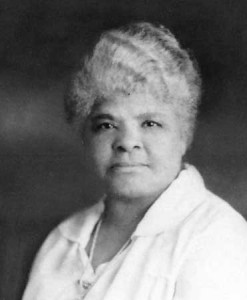
Ida B. Wells-Barnett: A real ride or die woman

Ida-Bell-Wells-Barnett-247x300By: Dr. Samori Swygert

Ida Bell Wells-Barnett is one of the most prolific African Americans in the annals and chronicles of United States History.  Many people are familiar with her, and conversely, many people are unfamiliar with her.  With that being said, allow her to receive her kudos, accolades, and acclaim today.

Ida B Wells was born a slave in 1862 in Holly Springs, Mississippi.  The nation was already deeply submerged in the Civil War.   She would eventually be orphaned because her parents fell victim to the 1878 Yellow Fever outbreak. She demonstrated her courage and independence by supporting herself and siblings as a teacher in Tennessee, and Mississippi up into the age of 29.

You’ll see that Ida B Wells was a trailblazer of African American nonviolent civil disobedience. She demonstrated her disdain for the unjust discriminatory practices that were rampant throughout numerous American institutions.  According to my reading, “in 1884 she filed a civil rights lawsuit against the Chesapeake, Ohio, and Southwestern Railroad for forcing her to give up her seat, the second African American after Sojourner Truth to do so”.  Sounds eerily reminiscent to Rosa Parks and others right?  She did receive money from the case, but the case was later overruled.

The pen is mightier than the sword

Ida began writing volumes upon volumes of articles, editorials, and essays addressing the atrocities and violations that African Americans experienced throughout the period of Reconstruction and beyond.  Her pseudonym/pen-name was “Iola”.

She wrote for: The Living Way, Free Speech and Headlight, The New York Age, and countless other newspapers of the day.  She was the editor of Free Speech and Headlight for 3 years.

Ahead of her time, she practiced the economic strategy of Boycotting to combat the injustices exacted upon African Americans.  This started when 3 of her close friends were “hung from trees, their bodies mutilated, on the outskirts of Memphis”.  March 9th 1892, Thomas Moss, Calvin McDowell, and William Stewart were the victims of this event.  Thomas Moss was slaughtered because he operated a competitive and thriving grocery store across the street from a white-owned grocery store.  Thomas’s flourishing business was viewed as an economic threat during Reconstruction.

Ida B Wells redirected that pain and anger into voluminous piercing writings instructing blacks to leave Memphis.  She wasn’t as successful as hoped, however that didn’t thwart her mission.  She then called for a boycott of the streetcars that operated in Memphis.  Reports say “over 2,000 blacks left Memphis, while the streetcars were almost bankrupt by the end of the summer”.

The gravity and impact of the boycott reverberated throughout Memphis and enraged the local white population.  They retaliated by incinerating her newspaper office to ashes.  Subsequently she absconded to the North.

Undeterred from the attack, she converted the threat into a fuel source for more passionate writings.  Their threats only emboldened her mission.  She conducted research into hundreds of nationwide lynchings and this generated her book.  Her book was entitled, A Red Record: Tabulated Statistics and Alleged Causes of Lynching in the United States, 1892-1893-1894.  This is considered the first statistical database of lynchings.  The book debunked the postulated propagandized beliefs of the wild, s*x crazed black men like the movie, BIRTH OF NATION by D.W. Griffith, portrayed about black men.  The movie’s intention was to scare white women, incite hate into white men, vilify African Americans, and justify the killings of African Americans.

Ida B Wells’s book infuriated the white demographic so much so they made a public announcement.   Here is the quotation: “If the negroes themselves do not apply the remedy without delay it will be the duty of those whom he has attacked to tie the wretch who utters these calumnies to a stake at the intersection of Main and Madison Sts., brand him in the forehead with a hot iron and perform upon him a surgical operation with a pair of tailor’s shears.” 

Shaming the nation into submission

Once again she converted all threats to fuel.  She traveled to England, Scotland, and Wales in 1893.  She vigorously broadcasted the grotesque inhumanities suffered by African Americans in an anti-lynching crusade.  Frederick Douglass even published a formal public praise of her diligence in reforming the violent inhumane practices within America.

Time to organize

Ida B Wells was also a cofounder of the NAACP, and is said to have bumped heads with Booker T Washington and other members because she was considered too radical/militant.  Eventually the NAACP excused her from leadership.  Her service continued, she organized the Negro Woman’s Club of Chicago.  She founded the National Association of Colored Women in 1896.  She founded the Negro Fellowship League. She founded the Alpha Suffrage Club in 1913.  The Alpha Suffrage Club’s aims were to stimulate the move for voting rights of African American women, and debunk the general white woman’s suffrage movement apprehension of African American men receiving voting rights before them.

She married a lawyer and editor, Mr. Ferdinand Barnett, they had 4 children.  Even though she was married with 4 children, she traveled through Illinois, Arkansas, and Ohio addressing the race riots that occurred, and fought against segregation in Chicago’s school system with Jane Addams.  She also joined in with the Universal Negro Improvement Association (UNIA) established by Marcus Garvey.

What kind of coffee was she drinking? zheesh!

It’s imperative that we share these stories of courage with our youth, because African American history is being excluded in the educational curriculums across the nation. Each generation born is a generation that needs this knowledge.  The only opportunity that this history is being conveyed is either at an HBCU, rare documentaries, black history month programs, or oral discourse from our elders that are passing away by the bulk in the 21st century.

Ida B. Wells Barnett REST IN PEACE (July 16, 1862- March 25, 1931)

Source:

  1. The African-American Century by Henry Louis Gates, Jr., and Cornel West, 2000
  2. Fifty Black Women Who Changed America by Amy Alexander, 1999
  3. Great African American Women by Darryl Lyman, 2005

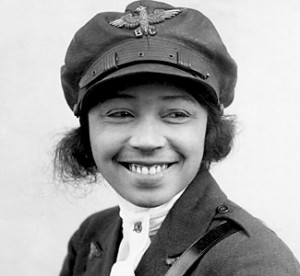
The Flyest Black Woman- Bessie “Queen Bess” Coleman

BESSIE~1Dr. Samori Swygert

Who is Bessie Coleman, and why is she the flyest black woman to me?  Bessie “Queen Bess” Coleman was the first African American Female Aviator, and entertainment pilot.  Bessie Coleman was born January 26, 1892 and died April 30, 1926.  American History makes a big fanfare about Amelia Earhart, but Bessie Coleman got her pilot license the same year Amelia Earhart got her first flight lesson in 1921.

Ms. Coleman has a very intriguing story.  She was born in Atlanta, Texas in 1892.  Her parents were Susan and George Coleman.  Her family moved to Waxahachie, Texas.  The family sharecropped cotton to live, sadly the father left and retreated to the Choctaw Reservation of Oklahoma.  The mother commandeered the family reigns and continued providing by picking cotton, and enrolling Bessie and her siblings in the labor.  Her mother purchased books for Bessie from a traveling library that graced the town twice a year.

Bessie’s interest for flight was sparked when she moved to Chicago to stay with her brothers in 1917.  Based on my readings, one brother was a Pullman Car Porter, and her other brother (Johnny) was a cook for Al Capone.  Johnny was a World War I veteran that amazed Bessie with all his combat stories.  She got a job in the beauty industry and worked as a manicurist.  She was trained at the Burnham’ School of Beauty Culture.

Ready for lift off!

Working as a manicurist in the local barber shop, she overheard countless tales and stories from African American World War I veterans.  She learned about the discrimination that black pilots experienced in the New York 15th and Illinois 8th black fighter regiments.  These two groups had fought in France.  She decided that she wanted to fly, so she quit her job. She looked for aviation schools that could teach African Americans and women.  America didn’t furnish the training institutions to accommodate her demographic (black women).  However, France did, and the French had female pilots in World War I.  Bessie started a Chili Parlor on 35th street and Indiana Avenue, and got two prominent African American investors, Robert Abbott (founder of Chicago Defender) and Jesse Binga (founder of Binga State Bank) to fundraise capital for her plans.

By the time Bessie was 24 years old, she had mastered the French language, sailed to Le Crotoy Somme, France, and matriculated into Condrau School of Aviation. 1921 the Federation Aeronautique Intenationale awarded Bessie her international pilots license, and this was the first ever granted to any American woman! 

Bessie honed her skills and moved to Paris.  When she decided to return to America, she ordered a 130 horsepower Neuport de Chasse plane  to be delivered to America, just in case America prohibited her from acquiring one within the country!  Unfortunately, the ugly double-headed monster of racism and sexism in America denied her employment in commercial aviation.  Frustrated she went back to Europe, and sharpened her skills.  She did advanced training in Germany, Holland, and Switzerland.  She flew 220 Horsepower Benz motor planes.  She was said to be an “ACE PILOT” by countless European aviation companies and stuntman.

Remembering her African American Roots

She returned to America in 1922 performing Nosedives, figure eights, climbs and other difficult flying maneuvers.  She would even take black audience members on her flights for $5 rides.  Bessie was so bold that she even parachuted out of her planes in airshows.  She never forgot her roots of African American inspiration.  During her flight exhibitions, she paid homage to the 8th Regiment of Illinois that she always heard tales about as a manicurist.  The band leader of the 8th escorted her to her plane, and they serenaded the audience with Jazz music as she flew through the heavens.

Keeping true to her African American roots, she returned to Waxahachie, Texas.  Historically speaking, the South was far from ready to see a black female pilot.  However, her tenacity weakened the system.  She was permitted to perform, but there was a catch.  African Americans were not allowed to see.  Bessie said she would not perform unless they permitted African Americans to enter… and they did!

She gave back to her community by giving speeches to African Americans at churches, schools, and other available venues.

Tragedy Strikes

1926, Jacksonville, Florida, the Negro Welfare League had invited Bessie to perform and honor her.  The availability, and accessibility of planes to African Americans had many restrictions and limitations at the time.  Many instances she had to fly refurbished, repaired, lower quality planes.  Sadly, the day before her show, she died in a practice run with a white co-pilot/mechanic.  Bessie was sitting in the back without a seatbelt, and was ejected from the plane.  Her mechanic died also died in the crash.  Sources say that an unsecured wrench had slid into the gearbox and jammed it.  Bessie tragically fell 500 feet.

Three funerals were performed in her honor and remembrance.  Her body was transported by train from Jacksonville to Chicago, and thousands swarmed to pay tribute.  Pastor Junius C. Austin conducted the services.  It is said he chastised the community for lack for financial support in helping her acquire quality standard planes.

Bessie wanted to start an Aviation School for Black Women, but tragedy struck and intercepted her dream.  However, I feel her dream, hard work, diligence, faith, fortitude and execution was enough.  I also love the fact that she came back to her community to enhance it.  I reread her story, and I really almost came to tears….for real.  However, she is another prominent example of our rich heritage.  Let’s continue to carry the torch and fly to higher heights.  The story of Bessie Coleman also highlights the greatness of our black women.

This makes her the flyest Black Woman to me! We’ve got to redefine the title Queen B, because Queen Bess was granted this decades ago.  Rest In Peace Bessie Coleman (January 1892- April 1926).

Source: The African American Century by Henry Louis Gates Jr. and Cornel West

Here are two YouTube videos to checkout:

1.  Bessie Coleman

2. Bessie Coleman: An American Hero