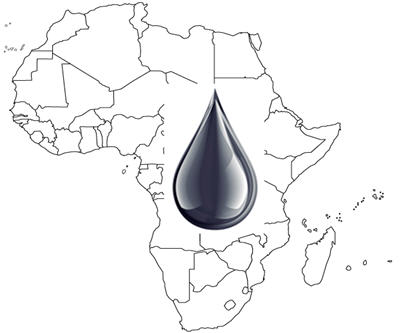
African resources in the crosshairs of global capitalism

african oil

African resources in the crosshairs of global capitalism

By: Dr. Samori Swygert

This month’s edition of Worth Magazine, a financial magazine, highlighted potential investments for 2014.  I reviewed some of the hotspots and focal points of investment.  The magazine highlighted Kenya and Mozambique as potential investment targets because of their untapped oil reserves.

I then researched the U.S. Department of the Interior, and the United States Geological Survey to correlate the magazine’s prospects with the data collected by America.  The wealth and resources of Africa are still abundant despite its’ history of plunder and pillaging.

Understanding the math

Before going any further, it’s important to understand the quantitative measurements that the data is reported in.

1 cubic foot= 28.3 liters

1 cubic foot= 7.6 gallons

1 barrel of oil= 42 gallons

1 barrel of oil= 5.6 cubic feet


These are important so that you have a relatable picture of the amount of volume in the reports that I’ve attached and sharing with you.

The technology

The U.S. uses high resolution satellite imagery, terrain analysis, and digital elevation models that allows them to calibrate the quantity of volume diamonds, and oil to be drilled or excavated.  Technically we can see what resources Africa has without actually being in Africa.  Think of it like a sonogram.  With a sonogram, you can see the image of the baby without having to actually enter the womb of the mother, you simply slather a little “jelly on the belly”, scan and view.


Diamonds are forever

A November 2012 fact sheet published by the United States Geological Survey reported that in Se’gue’la, Africa, there was a total of 10,100,100 carats of diamond deposits that have yet to be excavated.  Tortiya, Africa has a diamond reserve deposit of 1,100,000 that has yet to be excavated.  These two sections of Africa are located along the Ivory Coast.  The engineering, aerospace, luxury, and healthcare industries have many uses for diamonds, and I have no current updates of the amount of diamonds after this 2012 report.

The above info can be found here:  http://pubs.usgs.gov/fs/2012/3130/pdf/fs2012-3130.pdf


Slicker than oil

It is only logical that the U.S. engages in oil prospects as our demand for oil increases, and we try to become independent of OPEC for national operations.  This is why the Keystone Pipeline is the Big Steak on America’s dinner table.  African oil reserves are abundant and plentiful.  You may be wondering how plentiful right?


4 West African Provinces were analyzed and the results are jaw dropping.  America assessed the surrounding areas of Senegal, the Gulf of Guinea, the Niger Delta, the West-Central Coastal areas.  The survey estimates 71.7 billion barrels of oil, 187.2 trillion cubic feet of natural gas, and 10.9 billion barrels of natural gas liquids.  These were untapped and unexplored.  http://pubs.usgs.gov/fs/2010/3006/pdf/FS10-3006.pdf

Libya and Tunisia were analyzed in a 2010 geological survey.  The report furnished the following results:  3.97 billion barrels of undiscovered oil, 38.5 trillion cubic feet of undiscovered natural gas, and 1.47 billion barrels of undiscovered natural gas liquids.

 http://pubs.usgs.gov/fs/2011/3105/pdf/FS11-3105.pdf

 4 East African Provinces were analyzed.  The following areas were assessed: the Tanzania Coastal, the Seychelles, the Morondava, and the Mozambique coastal region.  The following results were reported by the United States Geological Survey: 27.6 billion barrels of oil, 441.1 trillion cubic feet of natural gas, and 13.77 billion barrels of natural gas liquids. 

http://pubs.usgs.gov/fs/2012/3039/contents/FS12-3039.pdf

 8 North African Provinces were analyzed.  The following areas were assessed: the Nile Delta Basin, Sirte Basin, Pelagian Basin, Trias/Ghadames Basin, Hamra Basin, Illizi Basin, Grand Erg/Ahnet Basin, and Essaouira Basin.  The following results were reported by the Geological Survey:  19 billion barrels of technically recoverable undiscovered conventional oil, and  370 trillion cubic feet of undiscovered conventional natural gas resources.

http://pubs.usgs.gov/fs/2012/3147/FS12-3147.pdf


It’s imperative that African nations are aware of the resources they possess.  The data retrieved by the survey didn’t involve invasive or diplomatically approved exploration, because this was conducted by satellite imagery and other methodologies.  Major technological advances and resources should be developed and made available to these African nations to extract these valuable resources in a safe and efficient manner.  The leaders of these nations must be very astute in their negotiations when granting exploratory and mining licenses to avoid exploitation which has been a repetitive, redundant, and recurrent theme in Africa’s history.  This is a tremendous bargaining chip for many of these nations.


This is also important considering the “mentioned” sanctions by the Obama administration of many African nations.  Food, medical and other aide is being held ransom-like by the U.S. for some African nations for failure to adopt or endorse homosexuality into their countries philosophy.   Also, are there potential business opportunities between African Americans and fellow Africans in the Motherland?

Click here so see that:

  1. http://www.forbes.com/sites/mfonobongnsehe/2011/12/09/obama-fights-nigerian-anti-gay-bill-threatens-to-cut-off-aid/
  2. http://www.bbc.co.uk/news/world-africa-23078655
  3. http://www.theguardian.com/world/2011/dec/07/gay-rights-us-aid-criteria
  4. http://www.washingtontimes.com/news/2013/jun/27/obamas-call-tolerance-gays-gets-cold-shoulder-afri/?page=all


What are your thoughts on the wealth of Africa’s resources and its’ global potential?

$$Wall Street speculates on kidney transplant market

kidneys transplantWall Street speculates on kidney transplant market

By: Dr. Samori Swygert

When people hear about selling your body, their psyche will typically project the image of prostitution or human trafficking.  However, the demand for human organs is at a premium, and the healthcare industry is poised to play as an active participant.

I had the opportunity to read a brilliant article by Gary Becker, and Julio Elias from the Wall Street Journal.  They elucidated the market demand, the associated reasons, and the parameters that will govern the economics of organ transplantation.

What are the facts?

According to Becker and Elias, the average waiting period for a kidney transplant is approximately 4.5 years.  The population of the kidney waiting list has basically doubled over 10 years from, 54,000 to 95,000 in 2012.  The list is inclusive of both genders, and all age brackets.  Individuals that have yet to receive a kidney remain on dialysis (a mechanized filtration system of the blood).  The average length of survival of a middle aged person on dialysis is approximately 8 years.  However, if blessed and afforded to receive a kidney transplant, their life expectancy gains another 24 years.  The authors of the article sadly reported that nearly 4,500 people died waiting for a kidney transplant in 2012.

“Time is money”

The sheer inconvenience of having to routinely schedule your whole life around numerous dialysis sessions can be overwhelming emotionally and mentally.  That in itself is an expense, the cost of peace of mind.  Well peace of mind is definitely disturbed with the actual monetary pricing of dialysis and kidney transplants.  Dialysis is a big ticket item on household budgets, because they average $80,000 per year.  You must then consider the 4.5 year wait time for receiving one.  That equation generates a figured expense of ~$ 350,000 from the cost of waiting alone.  The actual kidney transplant costs approximately $150,000, and you must still factor in the pharmaceutical expense for taking anti-rejection drugs for the kidney.

Maneuvering the market

To combat the wait time, save money, and save lives, many people and institutions are engaging in KIDNEY EXCHANGES.  This process facilitates and expedites the kidney donor/recipient matching process.  The problem is just finding a kidney, you must find a kidney that’s compatible with the blood type and tissue match of both recipient and donor, or the recipient’s body will reject it.

To meet the market demand for kidneys, proposals are being floated around for paying people for their kidneys.  Humans can live with one functional kidney, however many express reservations of parting with their organs.  The trepidation revolves around many reasons such as: fear of the risks associated with surgery, fear of lifestyle change, and time away from work.  To account for the fear, the authors propose a 3 month mandatory waiting period to allow donors to really think things through.

The price tag reported in the article ranges from a low of $5000 to a high of $15,000 per kidney.  The United States is not the only country considering this type of monetary-medical policy.  In fact, America is looking at its’ very own enemy, Iran, as a model.  Iran pays $4000 per kidney, and boasts a drastic reduction to virtual obsolescence of waiting times.

This costs an arm and a leg…or Kidney

The noted concerns in this new proposal is that this would construct a morally inhumane soliciting of the poor and disenfranchised.  The same way many individuals in financial binds will pawn items, or take out payday title loans, many people may turn to kidney donation as a financial solution.  Rather than donating a kidney to be physiologically philanthropic, individuals may resort to this. Economic climates like today, where unemployment is rampant, may provide an alternative means of revenue that wasn’t previously available.  The ultimate conclusion can be immense regret, especially considering that economics is a temporary and ever changing dynamic.  Kidney donation is very absolute and finite as opposed to sperm and egg donation where several reproductive cells are left.

Bottom line

In capitalism, everything is for sale, everything has a price, and everything can be negotiated.  Based on the capitalistic genetic makeup of America, I believe this will happen.  People must establish their own moral codes, altruistic/humanitarian philosophies, and system of priorities.  Organ donation is very noble, but I think you should do it for the right reasons.   Determine your reasons, be confident and comfortable with your choice.

Individuals should also note that the biotech industry is also developing body organs that are just like your internal organs.  This also brings the importance of good diet, health, and exercise.  These lifestyle modifications can cut down on the development of numerous conditions like kidney disease, heart conditions, and etc.

This seems like something that should be debated in Obamacare.  I can easily say that I received $15,000 for donating a kidney, but every year a person lives from my kidney should be tax deductible as per donating to life and reducing the strain on the United States Healthcare budget!  There are a lot of incentives and scenarios that should be reviewed if this system of pay for organs is approved.  We also must consider the loss in revenue from the medical device industry when the demand for dialysis drops.

Lastly, there would also have to be some regulatory commission to investigate if people were coerced into donations by Black Market Organ Harvesting operations, and the origin of kidneys to be sold in the market.  Also, why did the kidney waiting list double in 10 years?

Even Facebook sees opportunity

Facebook CEO Mark Zuckerberg has even thrown his hat in the ring to facilitate transplants using his database network.    http://abcnews.go.com/Health/abc-news-exclusive-facebook-tool-helps-organ-donors/story?id=16244991


Check out the source links and tell me your thoughts.

Sources

  1. http://online.wsj.com/news/articles/SB10001424052702304149404579322560004817176
  2. http://www.nytimes.com/2009/07/24/nyregion/24jersey.html?pagewanted=all&_r=0